Case study
Affiliate case study: an extra $15,048 in monthly revenue in 34 days, with no new content or links
This affiliate case study shows the process behind one of Convertica's earliest affiliate results. Robert's site already had the traffic. In August 2017 its monthly revenue went from $20,403 to $35,451 without a new article, a new backlink or a change to the sales copy, by working on the few places where visitors clicked and the few products that earned.
Affiliate case study at a glance
| Client | Robert, owner of a large affiliate review site (site kept private) |
|---|---|
| Vertical | Affiliate (Amazon and other affiliate programs) |
| Traffic | Over 200,000 unique views a month |
| Monthly revenue | From $20,403 to $35,451, August 2017 |
| What changed | Buttons, comparison tables and mobile layout where visitors clicked, then split tests on the top-earning products |
| What did not change | No new articles, no backlinks, no sales copy, no extra traffic |
| How it was measured | Monthly revenue before and after the work, plus click-through reports |
+$15,048
Monthly revenue, affiliate site, 34 days, August 2017
Source: Robert's affiliate site, monthly revenue before the work vs August (a before and after comparison, not a single split test)
Whose site was this?
The site in this affiliate case study belongs to Robert, who asked to keep it private. It is a large review site with over 200,000 unique views a month, earning from Amazon and from other affiliate programs. To keep it anonymous, the original write-up used "best dog trimmers" as a stand-in keyword, and so does this page.
Four people on Convertica's team made the changes, managed the tasks and pulled together the tracking and reports. That made it fast, but the process is the same for a site with 1,000 views a month: it comes down to applying it consistently.
What was the opportunity?
Robert's site already had the traffic, so the opportunity was in how much of it turned into affiliate revenue. Someone who searches "best dog trimmers" is close to buying: they know the solution and want to pick the right one. A good review page can tip them into a purchase on the affiliate partner's site, or lose them to a confusing layout and a link they cannot tap.
What is the 80/20 rule in CRO?
The 80/20 rule in CRO says that a small part of a website, roughly 20% of its pages, buttons and products, produces most of its clicks and revenue, roughly 80%. The ratio is never exact, sometimes 90/10, sometimes 95/5, but it is a reliable way to decide where to work first on a large site.
On Robert's site the 80/20 had two layers: the places on each page where visitors clicked, and the products that brought in the money. The process below finds both.
How did Convertica find and fix the 80/20?
Convertica's process for this affiliate case study had two passes. The first fixed the basics where visitors were clicking. The second doubled down on the products that earned most, and split tested the spots that linked to them.
Map where visitors click
Run heatmaps on the top pages for about 1,000 views each. They show which calls to action get attention and which clicks lead to an affiliate partner.
Check every page on mobile
In consumer markets, many visitors arrive on a phone. Look at each top page on one before you change anything.
Turn text links into buttons
A linked line of text is hard to tap with a finger. Large buttons make the next step obvious and easy.
Add a comparison table
Most readers skim a long review for its verdict. A table near the top gives it to them, and it must display properly on mobile.
Reset the heatmaps
After the changes, start the heatmaps again and collect another 1,000 or more views to see where the clicks go now.
Find the products that earn
Export a week or two of revenue, divide each product's revenue by the total, and list the roughly 20% of products that make about 80% of it.
Map the links to those products
Using the heatmaps, list every call to action and link that points to a product on that shortlist.
Split test those spots
Change one thing at a time on the shortlist, give each change at least 1,000 views, and keep what wins.
What changed on the pages?
Three changes did most of the work in the first pass, and none of them touched the sales copy:
- Buttons instead of text links. A line like "click here to buy this product" became a large button that is easy to tap.
- A comparison table on each top page. Readers who skim for the verdict see the products side by side, with the key specs, without reading a 5,000-word buyer's guide.
- Mobile fixes. Tables and buttons checked and adjusted so they display and work on a phone.
In the second pass, the split tests on the shortlisted products tried ideas like these:
- Button colors.
- Button text, for example "Click here for more info" against "Learn more".
- Page layout, for example the comparison table above the fold against below it.
What were the results?
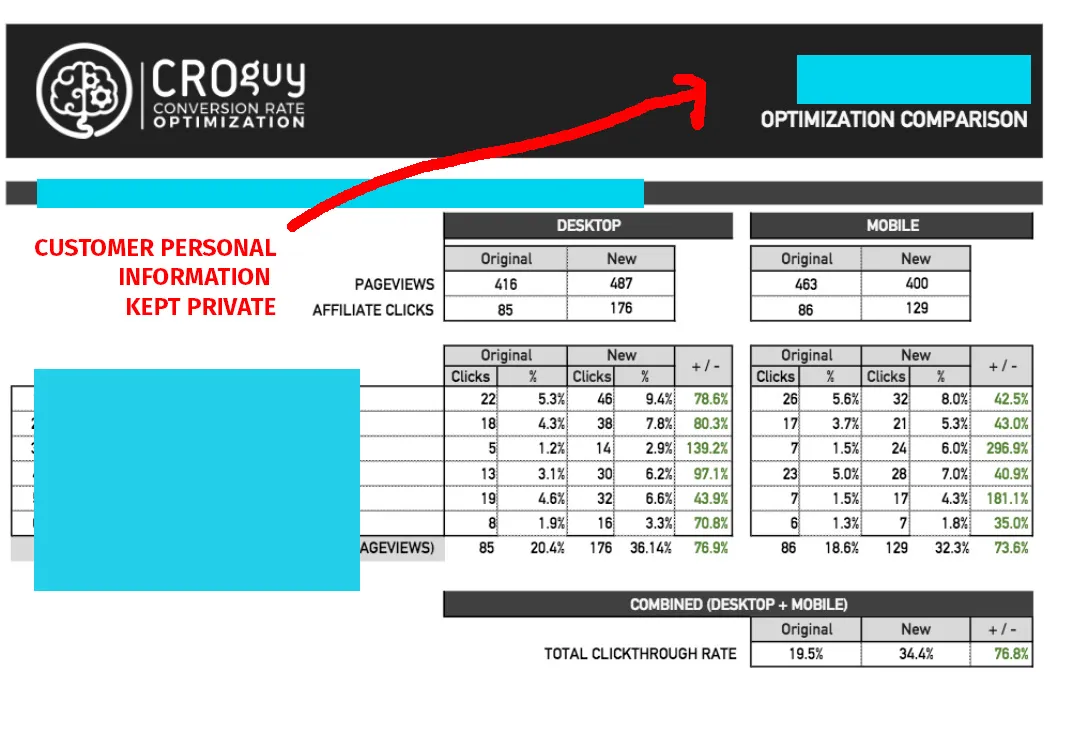
In August 2017 Robert's monthly revenue went from $20,403 to $35,451, an extra $15,048 for the month, in 34 days. The traffic, rankings and content stayed the same. A client report from the time shows the affiliate click-through rate on the reported pages rising from 19.5% to 34.4%, desktop and mobile combined.
How solid is the $15,048 figure?
The $15,048 figure is real revenue, but it is a before and after comparison, not the result of one controlled split test. It compares a month of revenue before the work with August. A comparison across months mixes in anything else that changed, such as season, demand for the products or the traffic mix, so read it as what happened on the site, not as what the changes alone caused.
The click-through report compares the original and new pages, but on a small sample: a few hundred pageviews per version on desktop and on mobile. It points the same way as the revenue, and that is the most it can do. Convertica's later affiliate campaigns, such as the 10Beasts case study, measured each version with its own Amazon tracking ID, so tests were judged in revenue.
Why did it work?
It most likely worked because the changes went where the money already was. Large buttons and comparison tables made it easier for ready buyers to act, on the pages and in the spots that already got the clicks, and the split tests then focused on the products that earned most. Small improvements on the busiest, highest-earning spots move total revenue more than big changes on pages nobody visits.
What can you apply to your own affiliate site?
You can apply this affiliate case study to any review site with steady traffic: find the spots where visitors click and the products that earn, make those spots easy to act on, then split test them one change at a time.
- Find your 80/20 before you change anything. Heatmaps for clicks, revenue reports for products.
- Make every call to action a button. Big enough to tap with a thumb.
- Give skimmers a comparison table. And check it on a phone.
- Double down on the products that earn. Test the links and buttons that point to them first.
- Change one thing per test. Several changes at once leave you guessing which one moved revenue.
- Size your tests properly. 1,000 views was the rule of thumb here; the A/B test sample size calculator gives the number your page actually needs.
- Do not depend on one affiliate program. Check which other programs cover the products and keywords you rank for.
Add one check for 2026: AI search now answers many "best" questions directly. If your verdict and comparison table are plain text in the page, an AI assistant can read and cite them. AI agent readiness is one of the eight checks in Convertica's free CRO audit.
Part 2 follows the same site over the next three months and about 50 split tests: read the affiliate income case study, part 2. To measure your own site first, see how to track affiliate marketing conversion rates.
Affiliate case study FAQ
What did this affiliate case study change?
It changed the parts of Robert's affiliate site that got the most clicks and earned the most: calls to action became large buttons, comparison tables were added and checked on mobile, and the products that brought in most of the revenue were then split tested in those spots. No articles, backlinks or sales copy were added or changed.
How much did revenue increase in this affiliate case study?
Monthly revenue went from $20,403 to $35,451, an extra $15,048 for the month of August 2017, in 34 days. That figure compares a month of revenue before the work with August. It is a before and after comparison, not the result of one controlled split test.
What is the 80/20 rule in CRO?
The 80/20 rule in CRO says a small share of a site, roughly 20% of its pages, buttons or products, produces most of its clicks and revenue, roughly 80%. The ratio is never exact; it can be 90/10 or 95/5. Finding that share first tells you where a change will pay back fastest.
How do you find the 80/20 on an affiliate site?
Use heatmaps to see where visitors click, and your affiliate revenue reports to see which products earn. Run the heatmaps for about 1,000 views per page, then export your sales, divide each product's revenue by the total, and list the products that make up about 80% of it. Those spots and products are where you test first.
How many views does a split test need?
The original case study used at least 1,000 views per change as a rule of thumb. The real number depends on your conversion rate and the size of the difference you want to detect: small differences need far more traffic. An A/B test sample size calculator gives a figure for your own page.
Should an affiliate site rely only on Amazon?
No. Robert's site earned from Amazon and from other affiliate programs, and the case study recommends checking which other programs cover the products and keywords you rank for. Relying on one program puts all of a site's income at the mercy of that program's rules and decisions.
Is there a part 2 of this affiliate case study?
Yes. Part 2 follows the same site over the next three months, when Convertica ran about 50 split tests back to back. It covers how to read early test data without fooling yourself, how test wins compound, and why traffic decides how fast you can learn.