Case study
JustThrive case study: revenue up 101.82% across two sequential split tests
This JustThrive case study shows how Convertica raised a supplement store's revenue with two split tests on its product page, run one after the other. JustThrive wanted more auto-ship subscriptions and a better return on its ad spend. The second test ran against the winner of the first, so the gains compound.
JustThrive case study at a glance
| Client | JustThrive, a health company based in Illinois, USA, selling supplements |
|---|---|
| Vertical | eCommerce |
| Goals | More auto-ship subscriptions and a better return on ad spend |
| Page tested | The product page |
| Test 1 | New variation vs the original page, 7 December to 15 January, 98% significance |
| Test 2 | Second variation vs the test 1 winner, 15 February to 24 March |
| Headline metric | Revenue, cumulative across both tests (not conversion rate) |
+101.82%
Revenue, cumulative across two sequential split tests, 7 December to 24 March
Source: JustThrive, revenue, two sequential split tests, Dec to Mar
+162%
Recurring revenue, cumulative across both split tests, 7 December to 24 March
Source: JustThrive, as stated in the original case study (calculation not published)
Who is JustThrive?
JustThrive is a health company based in Illinois, USA, that sells supplements online. Most of its traffic comes from search and from paid ads, which are costly. When JustThrive came to Convertica it had two goals: sell more auto-ship subscriptions, and get a better return on the money it spent on ads.
Both goals point at the same page. Ad spend only pays back if the product page turns visitors into buyers, and the auto-ship subscription is chosen on the product page too.
What was holding the product page back?
Convertica's audit of JustThrive's product page found two problems: buyers who arrive wary of supplement brands, and a page that asked them to choose between several versions of one product at the moment of purchase. The first costs trust. The second costs momentum, and it left the auto-ship subscription competing with the other options instead of standing out.
The review followed the same data-driven process Convertica uses for every audit, and it starts from four questions you can ask of any page:
- What is the one goal of this page?
- Does the page answer the visitor's intent and clearly show the path to a conversion?
- Do the images, the copy and the layout all work together toward that one goal?
- Does the page build trust and lessen anxiety or confusion?
1. Wary buyers
People shopping for supplements are often highly motivated: they have a problem they want solved now. Many have also been let down before by products that underdeliver, and stories of supplement scams online do not help. So they arrive cautious, holding their trust back. A page that does not earn it quickly loses them.
2. Too many choices at the point of purchase
JustThrive's product pages offered several variations of one product. A choice at the moment of purchase creates friction and can stall the decision altogether. Because JustThrive wanted more auto-ship subscriptions, the page could steer visitors toward that option rather than present every option as equal.
What was the hypothesis?
The hypothesis behind the first JustThrive test was that a calmer product page, with reassurance placed where the buying decision happens and the auto-ship subscription made the obvious choice, would turn more cautious visitors into buyers and more buyers into subscribers. It came from the audit findings, not from a list of best practices.
Three sources fed it:
- Google Analytics. The team went through JustThrive's analytics to see how visitors moved through the store.
- A heatmap. It showed where visitors clicked, or tried to click, on the product page.
- Earlier tests in the same niche. Hypotheses from tests Convertica had run before in this niche gave the team a starting list.
It stayed a hypothesis until the data said otherwise. Something that worked on one site is not guaranteed to work on another, even in the same niche, so the new design was tested against the original before anyone called it a win.
What changed in the first variation?
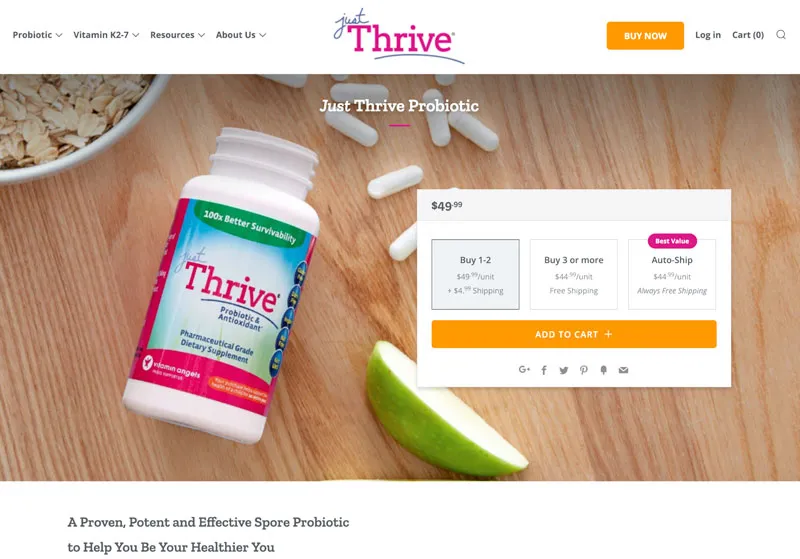
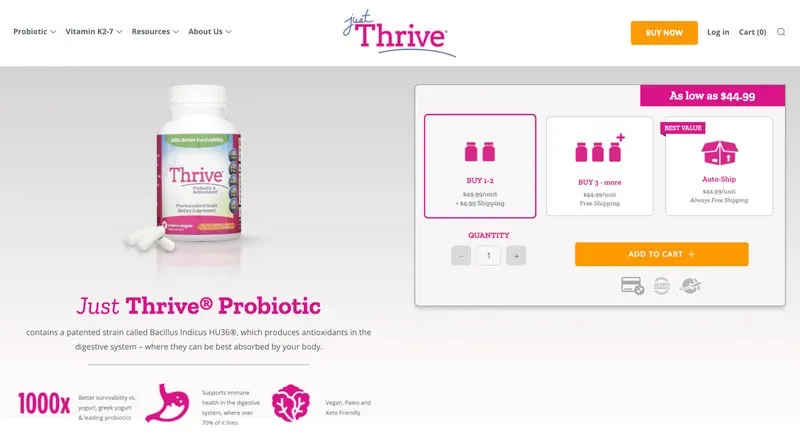
The first JustThrive variation changed three things on the product page, each tied to one of the audit findings:
- Less visual clutter. New product images, with more white space around them.
- Trust signals beside the Add to Cart button. Social media icons were replaced with icons for a 30-day guarantee, secure payment options and shipping.
- A more prominent auto-ship offer. An eye-catching "Best Value" label on the subscription option, and more emphasis on free shipping.
How were the two split tests run?
Both JustThrive tests were split tests on the live product page, run one after the other. Test 1 pitted the first variation against the original page. Test 2 pitted a second variation against the test 1 winner, so each result is measured against the best page at the time, not against the starting point.
| Detail | Test 1 | Test 2 |
|---|---|---|
| Control | The original product page | The test 1 winner |
| Main change | Less clutter, trust signals by Add to Cart, a "Best Value" auto-ship option | Auto-ship set as the default option, plus several other changes |
| Dates | 7 December to 15 January | 15 February to 24 March |
| Significance reported | 98% | Not stated in the original case study |
| Revenue result | +30.4% | +54.77% |
Test 1 results
The first variation went live on 7 December. On 15 January, a little over a month later, the results were in at 98% significance: more visitors bought, more of them chose auto-ship, and revenue rose.
+25.4%
Conversion rate, first variation vs the original page, Test 1, 7 December to 15 January
Source: JustThrive, split test 1 vs the original page, 98% significance
+41.5%
Auto-ship subscriptions, Test 1, 7 December to 15 January
Source: JustThrive, split test 1 vs the original page, 98% significance
+30.4%
Revenue, Test 1, 7 December to 15 January
Source: JustThrive, split test 1 vs the original page, 98% significance
The rise in auto-ship subscriptions mattered most, because that was the main goal.
What changed in the second variation?
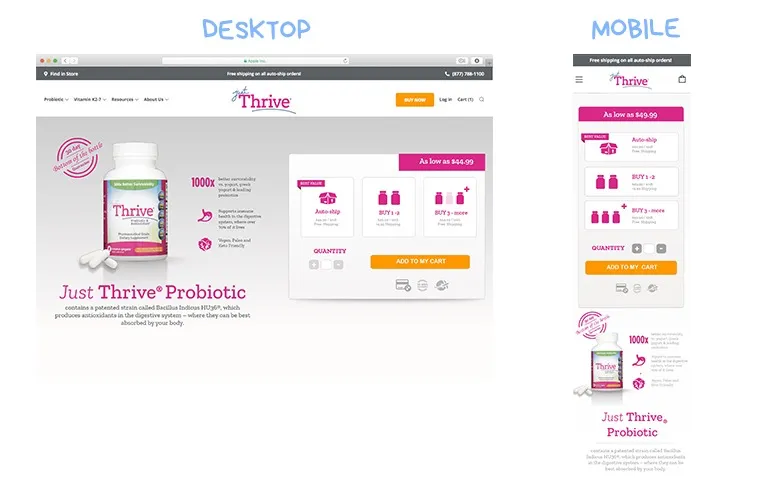
The second JustThrive variation made auto-ship the default product option, so a visitor who added to cart without changing anything got the subscription. It also changed several other elements at the same time, building on what the first test had shown. It ran against the first winner, not the original page.
Changing several things in one test breaks the usual rule. Most of the time Convertica changes as few elements as possible, so it is clear which change did the work. Here the aim was a faster result, using changes that had won in past tests, with a plan to scale back and test again if the variation lost.
Test 2 results
The second variation was released on 15 February and the results came in on 24 March. These figures compare it with the first winning variation, the page that had already lifted revenue in test 1, not with the original page.
+85.19%
Auto-ship subscriptions, vs the test 1 winner, Test 2, 15 February to 24 March
Source: JustThrive, split test 2 vs the test 1 winner
+53.73%
Total number of orders, vs the test 1 winner, Test 2, 15 February to 24 March
Source: JustThrive, split test 2 vs the test 1 winner
+54.77%
Revenue, vs the test 1 winner, Test 2, 15 February to 24 March
Source: JustThrive, split test 2 vs the test 1 winner
How do two split tests add up to 101.82% more revenue?
The JustThrive split tests compound because test 2 was measured against the test 1 winner. Test 1 multiplied revenue by 1.304. Test 2 multiplied that new level by 1.5477. Together, 1.304 x 1.5477 = 2.0182: revenue about twice the original page's, an increase of 101.82%, not the 85.17% you get by adding the two percentages.
| Stage | Revenue change | Multiplier | Revenue vs the original page |
|---|---|---|---|
| Original page | None | 1.000 | 1.000 |
| After test 1 | +30.4% | 1.304 | 1.304 |
| After test 2 | +54.77% | 1.5477 | 2.0182 (+101.82%) |
The original case study also reports a 162% cumulative increase in recurring revenue, the revenue from auto-ship subscriptions. It does not publish the calculation or the figures behind it, so that number is shown here as stated and cannot be checked from the page.
The whole sequence, from the launch of test 1 to the result of test 2, ran from 7 December to 24 March, and this page reports it by those dates.
Why did it work?
The JustThrive tests most likely worked because each change answered a specific audit finding: trust signals for wary buyers at the moment they decide, and a clear, preferred option instead of an open choice. Because test 2 changed several things at once, the case study cannot prove which single change mattered most, but auto-ship as the default was the main one.
Two details are worth noticing. In both tests, revenue rose faster than the headline count (conversion rate in test 1, orders in test 2), which may reflect more buyers choosing the subscription. And auto-ship subscriptions rose most of all in both tests, which is what the page had been redesigned to do.
What can you apply to your own store?
You can apply the JustThrive approach to any product page that sells a subscription or offers several versions of one product: decide the one outcome you want most, find what stands between the buyer and that outcome, change the page to answer it, and test each idea against your current best page.
- Name the one goal of the page. For JustThrive it was auto-ship subscriptions, and every change served it. A page that tries to do everything does none of it well.
- Put reassurance where the decision happens. A guarantee, secure payment and shipping details belong beside the buy button, not in the footer.
- Make the option you want chosen the easy choice. Label it ("Best Value"), give it visual weight, or test making it the default. Keep the terms of a subscription plain.
- Treat every idea as a hypothesis. Even changes that won on other stores. Test them against your page before you call them wins.
- Test the next idea against the new winner. One win is a starting point. Sequential tests compound.
- Judge tests on revenue, not only conversion rate. In both JustThrive tests, revenue and subscriptions moved more than the count of buyers did.
Before you test, check your product page against these questions from the original JustThrive write-up:
- Does a visitor know within a couple of seconds that they are in the right place?
- Are the product images crisp and clear enough to explain the page at a glance?
- Is the product description specific and complete enough to decide on the spot?
- Does the copy answer the questions and objections buyers have?
- If you offer free shipping, is it clearly written on the page?
- Is it clear that payment is secure?
- Is there an easy way to reach support, such as live chat or email?
Add one question that did not exist when JustThrive ran these tests: can an AI shopping agent read your price, your subscription terms and your guarantee? A page can persuade a person and still be hard for an agent to read. Agent readiness is one of the eight checks in Convertica's free CRO audit.
To plan your own tests, the A/B test sample size calculator shows how much traffic a test needs, and the statistical significance calculator checks a result. For a test on a membership store rather than a product page, read the dScryb case study.
JustThrive case study FAQ
What did the JustThrive case study test?
It tested JustThrive's supplement product page in two sequential split tests. The first variation cut visual clutter, put trust signals beside the Add to Cart button and made the auto-ship subscription more prominent. The second, tested against the first winner, made auto-ship the default option and changed several other elements at once.
How much did revenue increase in the JustThrive case study?
Revenue rose 101.82%, cumulative across two sequential split tests run from 7 December to 24 March. Test 1 raised revenue 30.4% over the original page. Test 2 raised it a further 54.77% over the test 1 winner. Multiplied together, 1.304 x 1.5477 = 2.0182.
Why is the cumulative figure 101.82% and not 85.17%?
Because the second test was measured against the first winner, not against the original page. A 54.77% gain on a page that already earned 30.4% more compounds: 1.304 x 1.5477 = 2.0182, a 101.82% increase. Adding the two percentages (30.4 + 54.77 = 85.17) understates the result.
How was the 162% increase in recurring revenue calculated?
The original case study reports a 162% cumulative increase in recurring revenue but does not publish the calculation or the figures behind it. Convertica shows it as stated and marks it as unverified on this page. The 101.82% revenue figure is the one with a published calculation.
Were the JustThrive results statistically significant?
Test 1 was reported at 98% significance after running from 7 December to 15 January. The original case study does not state a significance level for test 2, which ran from 15 February to 24 March. You can check your own test results with Convertica's free statistical significance calculator.
Why did the second test change several things at once?
To get a faster result. Changing one element per test makes it easy to say which change worked, and that is usually the rule. Here the team combined changes that had worked in past tests, with a plan to scale back and test again if the variation lost. The trade-off is that the case study cannot say which single change drove the gain.
Should I make a subscription option the default on my store?
Test it rather than assume it. Making auto-ship the default was the main change in JustThrive's second test, which raised auto-ship subscriptions 85.19% over the first winner. A default only helps if buyers understand it: show the subscription terms and how to cancel plainly, and check the consumer rules on subscriptions where you sell.
Can Convertica run this kind of test on my store?
Convertica starts with the free CRO audit, an app that checks your product page for people and for AI agents while you watch. After it, CRO advisory, led personally by founder Kurt Philip with Convertica's CRO team, then gives you ongoing direction on what to fix and what to test while your team builds the changes. Or, with full implementation, Convertica's team builds the fixes from your audit. Both are priced after your audit.